
Reducing SNF Staff Turnover: How Tech Becomes a Retention Lever

Do you know, improving staff retention often has less to do with hiring and more to do with how long it takes to complete a single chart?
That sounds surprising, doesn’t it? Well, this is reality.
In many SNFs, nurses don’t leave because of one big problem. They actually leave because of dozens of small ones repeating every shift. These may include duplicate documentation, delayed validations, unclear workflows, and systems that don’t talk to each other. Over time, that friction becomes the job itself.
This is why turnover in nursing roles continues to remain high even in facilities that have improved compensation and staffing ratios. The operational environment has simply become too fragmented for the workload it demands.
What’s changing now is the way leading operators are interpreting the problem. Rather than treating retention as an HR challenge alone, they are beginning to see it as a workflow design issue—where documentation burden, system complexity, and real-time decision support directly influence whether staff stay or leave.
That shift is also changing how technology is evaluated. It is no longer about feature sets or system upgrades, but about measurable reductions in effort per shift and clarity in daily workflows.
Let’s explore how that shift is happening in practice and why reducing staff turnover in SNFs is increasingly a technology and workflow problem, not just a hiring one.
Why pay alone doesn't work anymore
When we look at why pay alone doesn't work anymore through the lens of long-term care facilities, SNFs, and assisted living, the picture is more nuanced than the marketplace conversation suggests. Most teams approach this as a tooling question, but the leaders we work with treat it as a workflow design question first and a tooling question second. The difference shows up in deployment velocity, in user adoption curves, and ultimately in the durability of the gains six and twelve months out from go-live.
The practical framework starts with a sharp baseline. Before any eCareLTC capability is introduced, the team needs to agree on three numbers: where they are today, where they want to be in 90 days, and where they want to be in 12 months. Without those three numbers documented at the start, every subsequent decision becomes a debate about taste rather than a decision against a target. Teams that skip this step typically spend the first quarter relearning what they should have agreed on at the kickoff.
In practice, what this looks like is a structured pilot of 30 to 60 days with a small team that represents the diversity of the broader organization. Choose pilot participants who include at least one skeptic — the skeptic's feedback is more valuable than three enthusiasts combined, because the skeptic surfaces the friction that enthusiasts power through and that everyone else will trip over at scale. Capture quantitative metrics weekly and run a structured retrospective at week 4 to feed the configuration back into the deployment plan.
Two mistakes to avoid. First, do not confuse activity with progress: the number of users onboarded is not the same as the number of users who have changed their workflow. Second, do not optimize for the wrong number: it is easy to celebrate adoption metrics while the underlying outcome metrics (revenue, satisfaction, retention, time saved) stay flat. The teams that report the strongest results twelve months out are the ones that set their dashboards on outcomes from day one and watched those numbers weekly.
The shift from "hire harder" to "work easier"

When we look at the shift from "hire harder" to "work easier" through the lens of long-term care facilities, SNFs, and assisted living, the picture is more nuanced than the marketplace conversation suggests. Most teams approach this as a tooling question, but the leaders we work with treat it as a workflow design question first and a tooling question second. The difference shows up in deployment velocity, in user adoption curves, and ultimately in the durability of the gains six and twelve months out from go-live.
The practical framework starts with a sharp baseline. Before any eCareLTC capability is introduced, the team needs to agree on three numbers: where they are today, where they want to be in 90 days, and where they want to be in 12 months. Without those three numbers documented at the start, every subsequent decision becomes a debate about taste rather than a decision against a target. Teams that skip this step typically spend the first quarter relearning what they should have agreed on at the kickoff.
In practice, what this looks like is a structured pilot of 30 to 60 days with a small team that represents the diversity of the broader organization. Choose pilot participants who include at least one skeptic — the skeptic's feedback is more valuable than three enthusiasts combined, because the skeptic surfaces the friction that enthusiasts power through and that everyone else will trip over at scale. Capture quantitative metrics weekly and run a structured retrospective at week 4 to feed the configuration back into the deployment plan.
Two mistakes to avoid. First, do not confuse activity with progress: the number of users onboarded is not the same as the number of users who have changed their workflow. Second, do not optimize for the wrong number: it is easy to celebrate adoption metrics while the underlying outcome metrics (revenue, satisfaction, retention, time saved) stay flat. The teams that report the strongest results twelve months out are the ones that set their dashboards on outcomes from day one and watched those numbers weekly.
Charting time is the #1 dissatisfaction driver
When we look at charting time is the #1 dissatisfaction driver through the lens of long-term care facilities, SNFs, and assisted living, the picture is more nuanced than the marketplace conversation suggests. Most teams approach this as a tooling question, but the leaders we work with treat it as a workflow design question first and a tooling question second. The difference shows up in deployment velocity, in user adoption curves, and ultimately in the durability of the gains six and twelve months out from go-live.
The practical framework starts with a sharp baseline. Before any eCareLTC capability is introduced, the team needs to agree on three numbers: where they are today, where they want to be in 90 days, and where they want to be in 12 months. Without those three numbers documented at the start, every subsequent decision becomes a debate about taste rather than a decision against a target. Teams that skip this step typically spend the first quarter relearning what they should have agreed on at the kickoff.
In practice, what this looks like is a structured pilot of 30 to 60 days with a small team that represents the diversity of the broader organization. Choose pilot participants who include at least one skeptic — the skeptic's feedback is more valuable than three enthusiasts combined, because the skeptic surfaces the friction that enthusiasts power through and that everyone else will trip over at scale. Capture quantitative metrics weekly and run a structured retrospective at week 4 to feed the configuration back into the deployment plan.
Two mistakes to avoid. First, do not confuse activity with progress: the number of users onboarded is not the same as the number of users who have changed their workflow. Second, do not optimize for the wrong number: it is easy to celebrate adoption metrics while the underlying outcome metrics (revenue, satisfaction, retention, time saved) stay flat. The teams that report the strongest results twelve months out are the ones that set their dashboards on outcomes from day one and watched those numbers weekly.
Stack ranking which tech actually retains
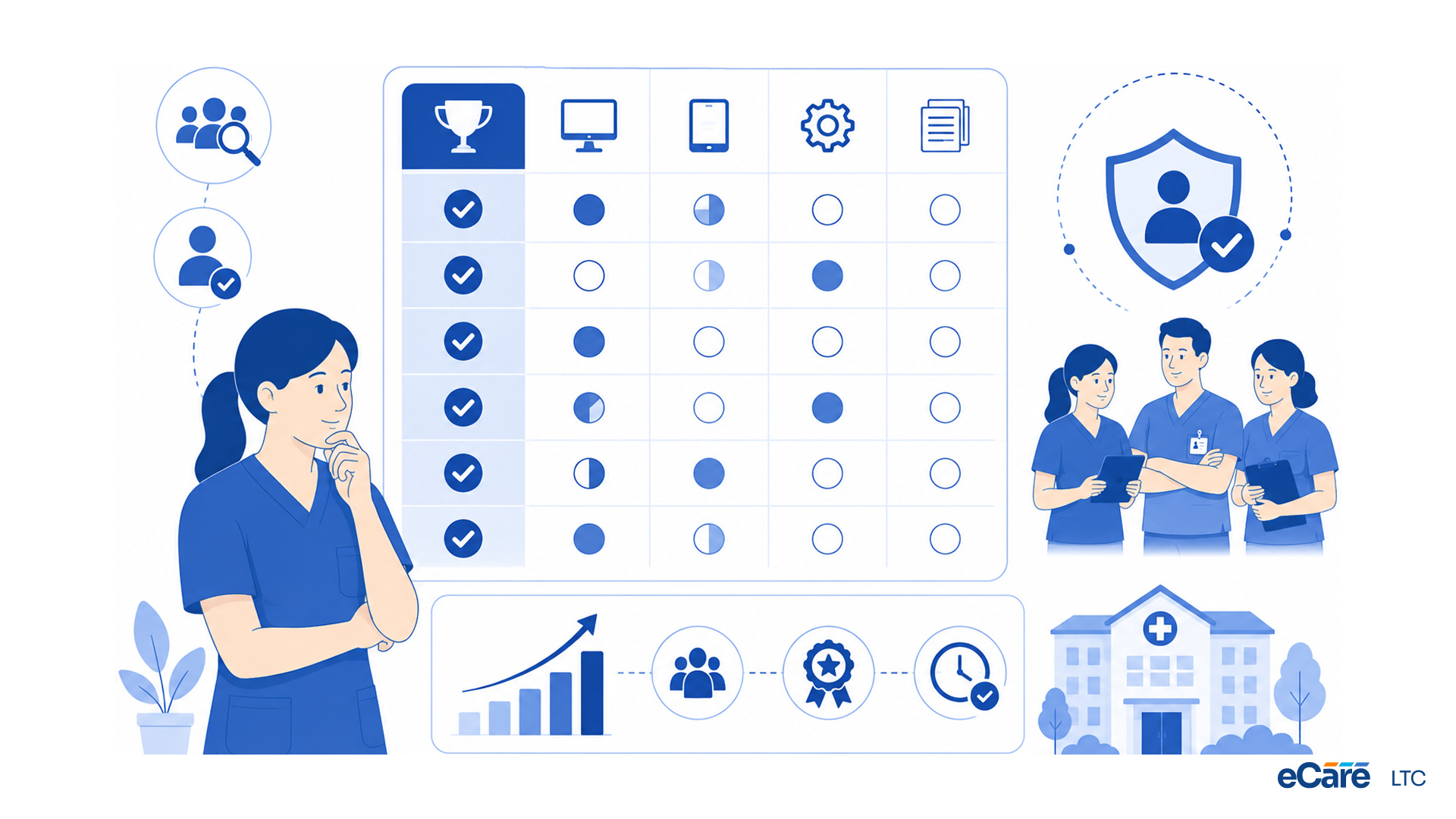
When we look at stack ranking which tech actually retains through the lens of long-term care facilities, SNFs, and assisted living, the picture is more nuanced than the marketplace conversation suggests. Most teams approach this as a tooling question, but the leaders we work with treat it as a workflow design question first and a tooling question second. The difference shows up in deployment velocity, in user adoption curves, and ultimately in the durability of the gains six and twelve months out from go-live.
The practical framework starts with a sharp baseline. Before any eCareLTC capability is introduced, the team needs to agree on three numbers: where they are today, where they want to be in 90 days, and where they want to be in 12 months. Without those three numbers documented at the start, every subsequent decision becomes a debate about taste rather than a decision against a target. Teams that skip this step typically spend the first quarter relearning what they should have agreed on at the kickoff.
In practice, what this looks like is a structured pilot of 30 to 60 days with a small team that represents the diversity of the broader organization. Choose pilot participants who include at least one skeptic — the skeptic's feedback is more valuable than three enthusiasts combined, because the skeptic surfaces the friction that enthusiasts power through and that everyone else will trip over at scale. Capture quantitative metrics weekly and run a structured retrospective at week 4 to feed the configuration back into the deployment plan.
Two mistakes to avoid. First, do not confuse activity with progress: the number of users onboarded is not the same as the number of users who have changed their workflow. Second, do not optimize for the wrong number: it is easy to celebrate adoption metrics while the underlying outcome metrics (revenue, satisfaction, retention, time saved) stay flat. The teams that report the strongest results twelve months out are the ones that set their dashboards on outcomes from day one and watched those numbers weekly.
ROI math your CFO will accept
When we look at ROI math your CFO will accept through the lens of long-term care facilities, SNFs, and assisted living, the picture is more nuanced than the marketplace conversation suggests. Most teams approach this as a tooling question, but the leaders we work with treat it as a workflow design question first and a tooling question second. The difference shows up in deployment velocity, in user adoption curves, and ultimately in the durability of the gains six and twelve months out from go-live.
The practical framework starts with a sharp baseline. Before any eCareLTC capability is introduced, the team needs to agree on three numbers: where they are today, where they want to be in 90 days, and where they want to be in 12 months. Without those three numbers documented at the start, every subsequent decision becomes a debate about taste rather than a decision against a target. Teams that skip this step typically spend the first quarter relearning what they should have agreed on at the kickoff.
In practice, what this looks like is a structured pilot of 30 to 60 days with a small team that represents the diversity of the broader organization. Choose pilot participants who include at least one skeptic — the skeptic's feedback is more valuable than three enthusiasts combined, because the skeptic surfaces the friction that enthusiasts power through and that everyone else will trip over at scale. Capture quantitative metrics weekly and run a structured retrospective at week 4 to feed the configuration back into the deployment plan.
If your team takes one thing from this section, take this: the measurement cadence matters more than the measurement choice. Weekly cadence with a forgiving metric beats quarterly cadence with a perfect metric every time. Tighter feedback loops compound. Set the rhythm at the start of the deployment, protect it through the first 12 weeks, and the rest of the playbook does most of its own work.
Conclusion
SNF staff turnover isn’t just a hiring issue—it’s a workflow issue. When charting, documentation, and coordination are fragmented, daily friction builds up and quietly drives people away.
The SNFs seeing better retention in 2026 are the ones reducing that friction through simpler, more connected workflows and less manual burden. Technology like eCareLTC helps by cutting repetitive work and making documentation more consistent at the point of care.
In short: when the work gets easier to do correctly, staff are more likely to stay.
Frequently Asked Questions
How long does a typical eCareLTC deployment take?
For most long-term care facilities, SNFs, and assisted living, a sensible first deployment runs 30 to 60 days from kickoff to first measurable result. The variables that move that timeline are the depth of integration required, the breadth of pilot users in week one, and the cadence of configuration review.
What is the realistic ROI window?
The earliest meaningful ROI signal is at day 30 to 45 — typically a workflow time metric that moves first. The financial ROI signal usually appears between month 3 and month 6, depending on which baseline KPIs you set at kickoff.
How does eCareLTC handle change management?
The change management problem is rarely about the tooling — it is about workflow design. eCareLTC deployments succeed when the leadership team owns the workflow change story and the vendor team owns the configuration.
What integration depth does eCareLTC require?
Most long-term care facilities, SNFs, and assisted living run a heterogeneous stack assembled over many years. eCareLTC integrates at the depth required by each system and exposes structured APIs for downstream tooling.
How do I evaluate eCareLTC against alternatives?
Score each vendor on five axes: workflow fit, integration depth, configuration flexibility, support quality, and pricing transparency. Insist on a 30-day live pilot before signing a multi-year commitment.